So you’re finishing up a degree at UH, Rice, Texas Southern, UHD, Houston Community College, or one of the other schools around the city, and you’re ready for a resume guide for Houston college students that actually gets you hired.
Here’s the honest version of how that works, without the fluff.
Houston Is Actually a Good Place to Be Job Hunting
It’s easy to assume every new grad is fighting over the same handful of jobs, but Houston’s economy doesn’t really work that way. Energy is the obvious one — oil, gas, and a growing renewable energy sector — but there’s also the Texas Medical Center, which is genuinely the largest medical complex in the world, a real aerospace industry thanks to NASA’s Johnson Space Center, plus finance, logistics, and a tech scene that keeps growing. Whatever your major, there’s usually a version of Houston’s economy that wants you.
The catch is that a lot of the bigger employers in those industries — especially energy, healthcare, and finance — run your resume through an applicant tracking system before a human ever lays eyes on it. Nobody teaches you that in a career center workshop, but it changes how you should actually build the thing.
It’s also worth knowing that “Houston job market” doesn’t just mean the big-name corporations either. There’s a whole layer of smaller companies and startups here too, particularly in tech and healthcare services, that hire differently than the big energy and finance firms — sometimes faster, sometimes with less rigid ATS filtering, and often more open to a candidate whose experience doesn’t check every box on paper. Worth keeping both in mind rather than aiming only at the household names.
It also means generic doesn’t cut it here. If your resume could apply to literally any job anywhere, it’s competing against every other new grad sending out the same kind of resume. One that’s clearly built for, say, a petroleum engineering role near the Energy Corridor or a clinical role tied to the Medical Center stands out mostly because so few students bother to tailor at all.
If you’re graduating soon, don’t wait until the last minute on this. A lot of the bigger energy and finance employers run structured recruiting months ahead of graduation, so if you’re aiming for spring, your resume really should be in shape by the fall before. If you’re past that window already, don’t panic — plenty of hiring at Houston’s small and mid-sized companies happens on a rolling basis year-round.
The Mistakes That Keep Showing Up
Before we get into what actually works, it’s worth naming what doesn’t, because these are the same handful of issues over and over.
The generic objective statement is probably the biggest one. “Seeking an entry-level position to utilize my skills” doesn’t tell anyone anything — cut it and use that line for something real instead.
Then there’s the habit of just naming a class instead of describing what you did in it. “Completed coursework in Financial Accounting” is weak. What did you actually build, solve, or produce? That’s the part worth writing down.
Heavily designed templates trip people up too. They look sharp to a human eye, but columns, icons, and graphics can genuinely confuse ATS software into misreading or skipping whole sections. Boring and readable beats stylish and broken, at least for this document.
Sending the exact same resume to an engineering role and a marketing role rarely works either — even small wording shifts make a real difference in how relevant you look. And a lot of students quietly leave off their campus involvement, student org leadership, or research work, which is a mistake when you don’t have years of paid work experience to lean on yet.
A few smaller ones worth mentioning: an old high-school-era email address (get a simple firstname.lastname one), inconsistent date formatting between jobs, and not bothering to mirror the actual language used in the job posting — which matters both for ATS keyword matching and for a human reader instantly recognizing the fit.
You Have More “Experience” Than You Think
This is where most students get stuck, so let’s actually walk through it. You don’t need years of full-time work history to write a strong resume — you need to frame what you already have the right way.
Coursework becomes real content once you stop naming the class and start describing the project. “Built a financial model for a semester-long capstone, then presented recommendations to a panel of industry professionals” says a lot more than “Completed Finance Capstone.”
Internships should be written up exactly like a real job, because they are one — role, organization, dates, and a few bullet points on what you actually did, results included, even informal ones like cutting down a weekly reporting process.
Leadership in a student org, a fraternity or sorority, or a club counts too. Managing a team, running a budget, planning an event — those are real skills, and they deserve the same framing you’d give an actual job.
If you assisted with faculty research or worked on a significant thesis or group project, especially in healthcare, engineering, or anything data-heavy, that belongs on the resume as well.
And don’t hide a part-time retail or restaurant job. It’s not glamorous, but it shows reliability and customer-facing experience that genuinely counts for something, especially this early on.
Study abroad, a semester spent balancing school with a family obligation, or a gap where you were working full-time to pay for tuition — none of that needs to be hidden either. Framed honestly, it usually reads as maturity and time-management ability rather than a red flag. The instinct a lot of students have is to only show the “impressive” parts of their story, but a resume that reads as genuinely you tends to land better than one that reads like it was written to impress an imaginary perfect employer.
A Quick Before-and-After
Weak: “Responsible for helping customers and handling cash register during shifts.”
Stronger: “Provided customer service for 50+ transactions daily while maintaining accurate cash handling in a fast-paced retail environment.”
Weak: “Worked on a group project for marketing class.”
Stronger: “Led a 4-person team to develop a social media marketing strategy for a local small business as part of a semester-long capstone project.”
Same underlying experience both times — the difference is just specificity. Numbers and outcomes turn a duty into something that actually reads as an accomplishment.
Formatting So the Software Can Actually Read It
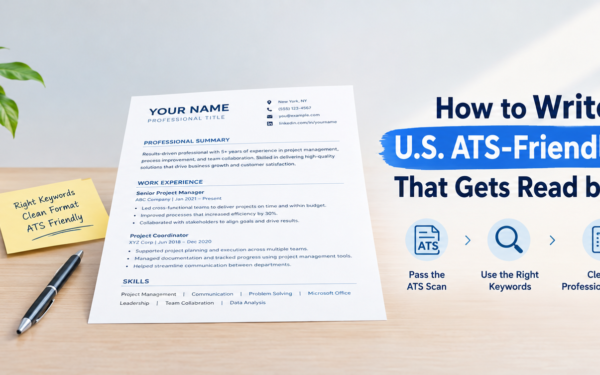
Since a lot of the bigger Houston employers run resumes through ATS software, formatting isn’t just a design choice — it affects whether a human ever sees your resume at all. Keep it to a simple, single-column layout, skip the tables and text boxes, and stick to standard section headings like “Experience” and “Education” rather than anything creative, since that’s what the software is built to recognize. Save it as a Word document or a text-based PDF, not an image file, use a normal font like Calibri or Arial, and actually pull keywords from the job posting where they’re genuinely true of your background or a broader look at how resumes and hiring tools are evolving, the U.S. Bureau of Labor Statistics’ Career Outlook is a solid, trustworthy resource worth a look..
How to Lay It Out
For a student or new grad, this order tends to work best: contact info up top (name, phone, email, city/state, LinkedIn if you have one); a short two-to-three-line summary of your skills and what you’re targeting instead of an objective statement; education near the top, since it’s often your strongest card right now — degree, school, graduation date, GPA if it’s solid, relevant coursework or honors; experience, meaning internships, part-time work, research, and relevant projects, written as accomplishments rather than duty lists; involvement and leadership; then skills, software, certifications, and languages that are actually relevant to what you’re applying for.
If your GPA is 3.0 or above, it’s usually worth including for your first job or two — it tends to matter less once you’ve got real full-time experience behind you.
A Word on Your Specific School
If you’re coming out of an engineering or business program — common strengths at UH and Rice — leading with technical skills and quantifiable project outcomes tends to work well. If your background leans more toward public affairs, communications, or pre-law, an area TSU is well known for, leading with communication, research, and leadership experience usually lands better. And if you transferred in from Houston Community College or somewhere similar, that’s worth stating plainly rather than leaving implied — it reflects adaptability and follow-through, which employers do notice.
Most career centers at these schools like University of Houston Career Services offer solid general guidance and a decent starting template, and it’s worth using what’s available to you there. Where it tends to fall short is depth — actually tailoring the resume to the specific roles and sectors you’re going after in Houston, making sure it’s genuinely ATS-readable and not just visually clean, and framing academic and internship experience so it reads as strong as it really is.
Don’t Skip Your LinkedIn
A lot of Houston employers will pull up your LinkedIn before or after they look at your resume, so treat it as a companion piece, not an afterthought. Make sure the headline says what you’re actually targeting instead of just repeating a job title, your experience roughly matches your resume, and you’ve filled in skills so you actually show up when a recruiter searches. If your resume and your LinkedIn tell two different stories, that’s the kind of small inconsistency that raises questions you don’t need raised.
What About a Cover Letter?
Most of the time, yes, you should still write one — even when a posting lists it as optional. It’s one of the few places you get to explain why you actually want that specific job, or add context a resume can’t hold on its own. It doesn’t need to be long. Three or four tight, specific paragraphs beat a generic template every time.
The mistake most students make with cover letters isn’t skipping them, it’s writing one that could be sent to any company with a find-and-replace on the name. If you can’t point to a sentence that only makes sense for that one employer, it’s worth another pass.
Questions Students Ask Us Most
Do I need real work experience to get a strong resume written?
No. Coursework, internships, research, campus leadership, and part-time jobs can all be framed as real experience, especially at the entry level.
Should a new grad resume be one page?
Almost always, yes. A tight single page nearly always beats two pages padded out with weaker content, unless you genuinely have enough relevant experience to justify the extra space.
Do Houston companies actually use ATS for entry-level roles?
A lot of the larger ones do, particularly in energy, healthcare, and finance — which is exactly why the formatting side of things matters even for a first job out of school.
What if my degree doesn’t really match the job I’m going for?
Lean into transferable skills and relevant projects instead of the major title itself. A resume can be built around what you can actually do, not just what your diploma says.
Should I include my GPA?
If it’s 3.0 or higher, generally yes, especially early on. It matters less once you’ve got real full-time experience to show instead.
How is a resume for energy or healthcare different from other fields?
Employers in regulated, technical industries tend to weigh certifications, safety training, and precise factual language more heavily than creative phrasing — worth keeping in mind if that’s the direction you’re headed.
Ready to Build a Resume That Actually Gets You Hired?
Graduating and stepping into Houston’s job market is a lot, and your resume is one of the few parts of it that’s fully in your hands. If you’d rather have someone take your coursework, internships, and campus experience and turn it into a resume built the way Houston employers and ATS systems actually read it, ResumeProWrite can help. Reach out for a free consultation and let’s build something that matches where you’re actually headed next.