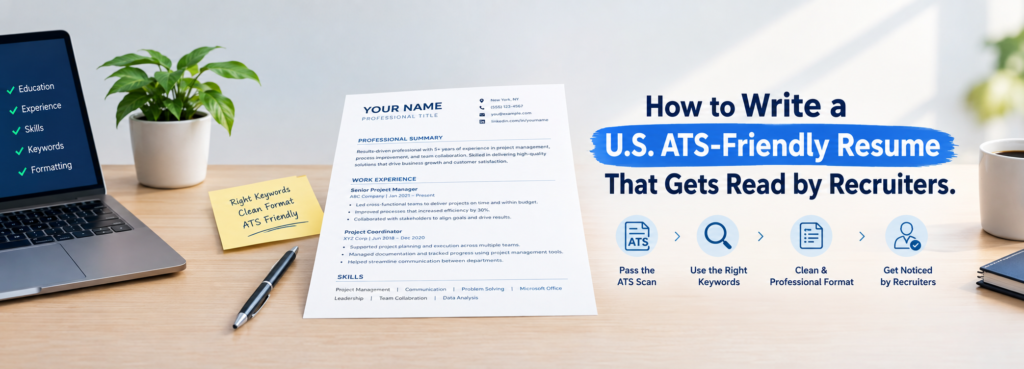
A strong ATS-friendly resume can still be overlooked if the system reading it can’t parse the formatting correctly. Many employers use ATS software to collect applications, organize candidate information, and identify resumes that match a job description. Your resume must succeed twice: it must be easy for software to parse and persuasive when a recruiter opens it.
An ATS-friendly resume is not a document filled with hidden keywords or complicated tricks. It is a clear, relevant, well-structured resume that uses standard formatting and explains your qualifications in the language employers use. If a recruiter can quickly see what you do, what you have improved, and why it matters to this role, the resume is doing its job. The goal is not to “beat” the system. It is to make your real experience easy to find, understand, and evaluate.
This guide uses American resume conventions and terminology, including “resume” rather than “CV” for most private-sector applications.
For most U.S. employers, do not include a photograph, age, marital status, Social Security number, or unrelated personal information. Include your name, phone number, email address, LinkedIn URL when relevant, and city and state. Federal applications are different, so USAJOBS candidates should follow the announcement’s instructions and consider our federal resume writing service.
What is an ATS-friendly resume?
An ATS-friendly resume is formatted and written so applicant tracking software can correctly identify important information such as your name, contact details, job titles, employment dates, skills, education, certifications, and achievements. It also uses relevant terminology from the job posting without exaggerating or misrepresenting your background. [1] [2]
ATS platforms do not all work in exactly the same way. Each employer may configure its system differently, and some systems perform more advanced searches than others. For that reason, no honest resume service can guarantee that every resume will receive the same score or produce an interview. However, clean structure, standard headings, relevant keywords, and accurate content give your application a stronger chance of being processed correctly.
If you want professional help with this process, see our ATS resume writing service. Our approach combines parseable formatting with content that still sounds natural to a hiring manager.
1. Start with the job description, not a generic template
The most important ATS strategy is to tailor your resume to the role. A generic resume may contain good experience, but it can fail to show why that experience matches a specific opening.
Read the job description carefully and identify the terms that describe the American employer’s needs. Look for the target job title, technical skills, software, certifications, industry terminology, responsibilities, and qualifications. Separate the requirements you genuinely meet from those you do not. Then use the relevant terms in your resume where they accurately describe your experience.
For example, a U.S. marketing job description may mention campaign management, paid search, Google Analytics, content strategy, conversion rates, and cross-functional collaboration. If you have performed that work, those concepts should appear naturally in your professional summary, skills section, and achievement bullets. Do not simply copy a long list into your resume. Show how you used the skill and what happened as a result.
Use the employer’s language when it truthfully matches your background. If a posting says “project management” and your resume only says “coordinated tasks,” consider whether the first phrase accurately describes your work.
2. Use a simple, readable resume format
An ATS usually reads text in a linear order. Complex visual layouts can interrupt that order or cause important information to be placed in the wrong section. For online applications, the safest choice is usually a clean, single-column layout with consistent spacing and conventional typography.
Avoid tables, text boxes, graphics, icons, logos, charts, and decorative elements that carry essential information. Avoid placing contact details in a header or footer if the application system may not extract them correctly. Two-column designs can look attractive, but they may cause the software to read the right column before the left column or combine unrelated content.
Use a common, legible font such as Arial, Calibri, Cambria, Georgia, Helvetica, or Times New Roman. A font size around 10 to 12 points is generally readable for the main text. Use bold formatting sparingly to make job titles and headings easy to scan, but do not turn the resume into a graphic design project. [1] [2]
The best format depends on the instructions in the job posting. Many U.S. employers accept PDF or Microsoft Word documents, but you should follow the requested file type whenever one is specified. Before submitting, open the final file and check that the layout has not shifted. You can also copy the content into a plain-text document to see whether the sequence remains logical and whether any information disappears.
3. Use standard section headings
Standard headings make your resume easier for software and people to navigate. Use familiar labels such as:
- Professional Summary
- Work Experience
- Skills
- Education
- Certifications
- Projects
- Professional Affiliations
Creative headings may sound distinctive, but they can make your information harder to classify. For example, “Where I Have Made an Impact” may be less clear than “Work Experience.” A recruiter should never have to guess where to find your employment history or technical skills.
Keep your employment entries consistent. A common U.S. structure is job title, employer, city and state, and dates, followed by achievement-focused bullet points. Use one date format throughout, such as “March 2022–Present” or “03/2022–Present.” Consistency improves readability and reduces confusion.
4. Write a targeted professional summary
Your summary is one of the first sections a recruiter sees. It should quickly explain who you are, what you do, and what value you bring to the target role. Avoid vague statements such as “hardworking professional seeking a challenging opportunity.” They use valuable space without showing your qualifications.
Instead, write two to four sentences that combine your professional identity, years or level of experience, relevant specialties, and one or two measurable strengths. For example:
Cybersecurity analyst with five years of experience monitoring enterprise environments, investigating incidents, and improving endpoint protection. Experienced with SIEM platforms, vulnerability management, incident response, and cross-functional risk reporting. Reduced average incident triage time by 30% through workflow improvements and analyst training.
This summary includes a target profession, relevant keywords, a clear scope of experience, and evidence of impact. It does not claim expertise the candidate cannot support.
5. Turn responsibilities into measurable achievements
A resume that only lists duties can look like a job description. Recruiters need to understand what you accomplished while performing those duties. Whenever possible, transform a responsibility into an achievement by explaining the action, the method, and the result.
Weak example:
Responsible for managing customer accounts.
Stronger example:
Managed a portfolio of 85 customer accounts, improved renewal communication, and increased annual retention by 14%.
The second bullet still contains a relevant responsibility, but it also provides scope and outcome. That distinction is what turns a resume from a list of tasks into evidence. Use numbers when they are accurate: revenue, savings, time, volume, team size, customer count, productivity, quality, or delivery speed. If exact numbers are confidential or unavailable, describe the result precisely without inventing data.
Begin bullets with specific action verbs such as led, built, improved, analyzed, negotiated, launched, reduced, streamlined, or delivered. Then connect the action to the business result. This helps the recruiter see not only what you were assigned to do, but how effectively you did it.
6. Build a truthful keyword strategy
Keywords should appear in context. Include relevant terms in your summary, skills section, and experience bullets when they reflect your actual background. If you have used a tool, name it. If you hold a certification, write its full name and abbreviation where appropriate. For example, “Project Management Professional (PMP)” may be clearer than using only one version.
Do not add keywords in white text, hide them in the footer, repeat them unnaturally, or include skills you cannot discuss in an interview. Keyword stuffing can make a resume difficult to read and may damage your credibility. The strongest keyword strategy is evidence-based: mention the qualification, show how you used it, and describe the result.
Tailor the resume for the role instead of sending the same version everywhere. A software engineer, healthcare administrator, and project manager may all have transferable strengths, but each application should emphasize different terminology and achievements. A targeted resume is more relevant to the employer and more useful to the person evaluating it.
7. Keep the resume length appropriate for your career stage
There is no universal page limit for every candidate in the U.S. market. Entry-level and early-career candidates can often present their qualifications effectively on one page. Experienced professionals may need one to two pages to explain a substantial record of relevant accomplishments. Executives and federal applicants may require longer documents because their formats and qualification requirements are different.
Length should serve relevance. Remove old, unrelated, or repetitive content before shrinking the font or margins. Give the most space to the work and achievements that support your current target role. If you are changing careers, emphasize transferable skills, relevant projects, training, and outcomes that connect your previous experience to the new field.
ResumeProWrite offers support for entry-level resumes, mid-career professionals, executives, and career changers.
8. Make your resume and professional profile tell the same story
Your resume is not the only document recruiters may review. Your cover letter and LinkedIn profile should reinforce the same target role, achievements, career direction, and professional language. They do not need to repeat every sentence, but they should not create contradictory timelines or different versions of your expertise.
A consistent professional story makes your application easier to trust. Your cover letter writing service can help connect your strongest experience to a specific opportunity, while our LinkedIn profile writing service can align your public professional presence with your job-search goals.
Final ATS-friendly resume checklist
Before you upload your resume, confirm that it meets the following standards:
- The resume is tailored to the job description.
- Relevant keywords appear naturally and truthfully.
- The layout is single-column, clean, and easy to scan.
- The document avoids tables, text boxes, graphics, and unnecessary icons.
- Section headings use familiar labels.
- Job titles, employers, locations, and dates are easy to identify.
- Bullets describe achievements instead of repeating duties.
- Numbers and results are accurate.
- The file type follows the employer’s instructions.
- The final document looks correct when opened and copied as plain text.
- The resume matches the story presented on LinkedIn and in the cover letter.
- Every claim is something you can confidently explain in an interview.
Give your resume a better chance of being read
An ATS-friendly resume is not about tricking software. It is about removing avoidable barriers and presenting your qualifications in a structure that both technology and people can understand. Before you upload it, read the first half of the page as if you were a busy recruiter: can you tell what role this person wants, what they are good at, and what results they have produced? Use a simple layout, standard headings, relevant keywords, measurable achievements, and honest language.
If your resume is not producing the response you expect, the problem may be its structure, positioning, or relevance rather than your ability. ResumeProWrite’s professional resume writing services combine a conversation about your experience with recruiter-focused writing and ATS-friendly formatting. You can compare resume packages and pricing or contact ResumeProWrite to discuss the U.S. role you are targeting and the support that fits your career stage.
No resume can guarantee an interview or job offer. A well-built resume can make your qualifications clearer, more relevant, and easier to evaluate before a recruiter takes the next step.
References
[1]: https://capd.mit.edu/resources/make-your-resume-ats-friendly/ “MIT Career Advising and Professional Development: Make Your Resume ATS-Friendly”
[2]: https://www.indeed.com/career-advice/resumes-cover-letters/ats-resume-template “Indeed: How to Write an ATS Resume”


3 Comments